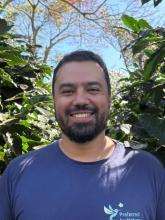
A passion for coffee: Meet Sebastián Arrieta Bolaños and his private coffee haven
On a small family farm near San José, Sebastián Arrieta Bolaños, Coffee Commodity Lead for Preferred by Nature, has spent more than a decade turning depleted land into a thriving organic coffee ecosystem. His hands-on experiments in soil, shade and biodiversity now inform his global work with Preferred by Nature—offering a hopeful blueprint for climate-resilient coffee farming. Meet our Coffee Commodity Lead.
On the outskirts of San José, where the city slowly gives way to green hills, Sebastián Arrieta Bolaños walks between coffee plants that tell a very different story from a decade ago. Birds move through the shade trees overhead. The soil is dark, alive, and soft underfoot.
“This plantation was an old conventional plantation,” Sebastián says. “They controlled the diseases with fungicides, pesticides and insecticides.” When his family bought the land in 2013, it was almost empty—degraded soil, little biodiversity, and no functioning system. What began as a simple idea to grow food for the family soon grew into something far more ambitious.
Today, the farm has become a living expression of the thinking behind Preferred by Nature Certification (PBNC), says Sebastián.
From chemicals to ecosystems
“We began to grow our own crops, some eggs and meat from birds,” he recalls. Over 12 to 13 years, that modest beginning evolved into a diversified agroecological system: shade-grown coffee, organic fertilisation made on-farm, and a steady return of life to the land.
Climate change has reshaped everything. “The coffee behavior has changed a lot,” Sebastián explains. “Right now it’s reduced to a small part of the year.” Harvests are shorter and less predictable, labour harder to secure, and chemical fertilisation increasingly expensive.
His response was not to intensify inputs, but to redesign the system. “We have to make this kind of small ecosystem to try the plant to adapt easier to this climate change,” he says. Shade trees, compost from prunings, organic matter, and locally collected mountain microorganisms became central. “We’re trying not to buy anything from outside. We’re trying to produce everything here.”
The transition was not easy. “When I began to prune the plants and to plant new varieties, it was a big challenge,” he admits. But over time, the soil recovered—and the plants followed. “The plants began to adapt to this small environment, and it changed a lot.”
A farm that teaches
The results are now visible without data sheets. “Very good results in yields, in the condition of the plant, in the coffee cupping” Sebastián says. “The plants are talking on their own.”
Biodiversity returned too. “We have a lot of birds, reptiles, and snakes. At the beginning, this was not here.” Migratory birds now rest on the farm, and the ecosystem increasingly regulates itself—reducing disease pressure and buffering climate extremes.
The project is fully seed to cup. “We put the seed, we grow the plant, and right now we are selling our own coffee in bags,” he says. In Costa Rica, where only Arabica can be grown, quality—not volume—is everything. His coffee reflects the system behind it: organic, traceable, and carefully built over time.
Sebastián now wants to open the farm to others. “I want to bring some producers here and show them that it is possible to produce without chemics,” he says. Training, he believes, should be practical: soil management, pruning, varieties, harvesting, and processing—all learned in the field.
It is this blend of patience, experimentation, and respect for natural systems that makes Sebastián emblematic of Preferred by Nature’s approach. His farm is not just productive—it is proof that climate-resilient, organic coffee farming can work, when the ecosystem is allowed to lead the way.
Learn more about Preferred by Nature Certification.
Follow Sebastian on Instagram.
Featured photo: When taking time off from his job as a Coffee Commodity Lead for Preferred by Nature, Sebastián enjoys nurturing his family’s 3000 m2 plot of land – an organic and biodiversity haven with 13 varieties of coffee.
Photo: Benjamin Holst / Preferred by Nature


Contributors: