Rural Communities Transformation and Restoring Ecosystems for Sustainable Natural Rubber in Xishuangbanna — Phase II
Building on the results of Phase I, this project continues to promote sustainable rubber production and enhance rural livelihood in Xishuangbanna, Yunnan Province, China's key natural rubber production region.
Phase II focuses on strengthening sustainable land-use practices through three interconnected pillars: empowering communities toward sustainability, supporting Forest Stewardship Council (FSC) certification for smallholder rubber farmers, and building local capacity for ecosystem restoration.
Xishuangbanna accounts for over 27% of China's rubber plantation area, but rapid monoculture expansion has converted large portions of tropical forest, threatening native species and reducing ecosystem services. The region has experienced significant natural forest loss in recent years, contributing to substantial CO₂ emissions. Socially, rural communities face income instability due to dependence on a single-crop, urban outmigration causing labour shortages, limited infrastructure, and the risk of losing traditional cultural knowledge tied to the land.
The project directly benefits 240 households of smallholder rubber farmers in Menghan Township, Xishuangbanna. Beneficiaries are primarily from the Dai and Hani ethnic minority communities, who have traditionally depended on rubber cultivation as their primary source of income.
The project aims to advance sustainable management of the natural rubber supply chain in Xishuangbanna by improving smallholder livelihoods, ensuring environmental compliance, and restoring degraded ecosystems across three pillars.
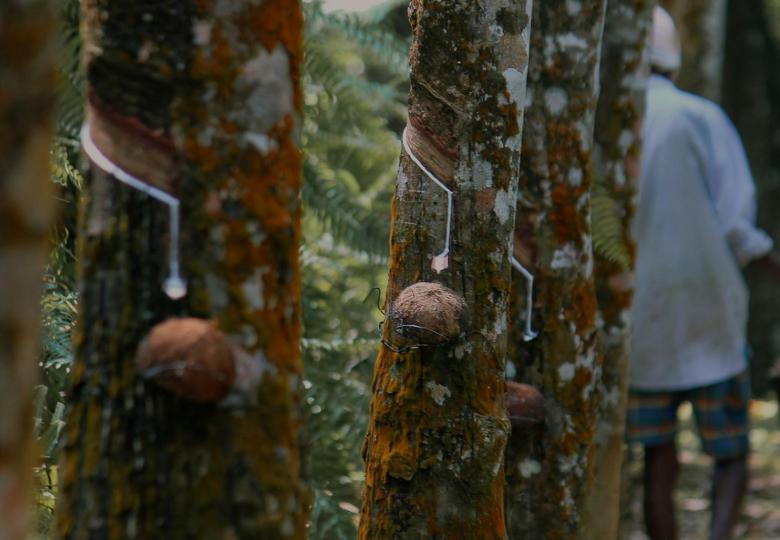
Pillar 1 focuses on community empowerment through a "Sustainable Living and Production Skills Competition" that coverwaste sorting, rubber tapping, pesticide use, and agroforestry, along with practical actions like environmental pesticide management in rubber plantations and road repair at damaged sites.
Pillar 2 supports smallholders in pursuing FSC Group Certification by organising farmer groups, conducting pre-audit assessments, delivering targeted training, providing technical support, and establishing a long-term framework for HCV management and certification maintenance.
Pillar 3 builds ecosystem restoration capacity through Training of Trainers (ToT) sessions for farm leaders, peer-led community workshops on restoration and agroforestry techniques, and a multi-stakeholder workshop to share best practices and explore additional restoration opportunities.
Expected Solutions and Impact
The project aims to improve rubber production safety and efficiency, increase smallholder incomes through access to FSC-certified premium markets, strengthen collective bargaining through farmer groups, and restore biodiversity and soil health in degraded plantation areas. Communities will gain durable skills in sustainable production, ecosystem management, and regulatory compliance aligned with EUDR requirements.
Innovation and Replicability
Phase II builds on a proven Phase I model, demonstrating that FSC certification and ecosystem restoration techniques can be implemented at the community level in a cost-effective and scalable way with this funding mechanism. The Training of Trainers approach and integrated community-engagement model are designed for replication across the Mekong River Basin and other Southeast Asian rubber-producing regions, such as Thailand, Indonesia, and Vietnam, where similar smallholder and environmental challenges exist.


Project Details:
Title
Rural Communities Transformation and Restoring Ecosystems for Sustainable Natural Rubber in Xishuangbanna Phase II 2026
Shuang Hu
Together we are stronger

Assessing due diligence regulations preparedness in South-East Asia and related supply chains
Due diligence rules in consumer markets are increasingly driving changes in producing countries to reduce environmental and social...
Rural Communities Transformation and Restoring Ecosystems for Sustainable Natural Rubber in Xis...
Building on the results of Phase I, this project continues to promote sustainable rubber production and enhance rural livelihood i...

Improving sustainable livelihoods for smallholder rubber farmers in Xishuangbanna
This project aims to promote sustainable land use and improve livelihoods in Xishuangbanna, Yunnan Province, a key region in China...

Innovation Alliance for Training Programmes for Deforestation-Free Supply Chains in Europe (EMM...
Deforestation is the primarily result of the expansion of agricultural land for forest risk commodities (FRCs) such as cattle, woo...