This page provides a detailed overview of the EU Deforestation Regulation (EUDR), including its scope, timelines, due diligence requirements and recent amendments. It is intended for organisations and practitioners seeking a deeper understanding of how the regulation works in practice and how it continues to evolve.
Jump to a specific section:
What is the EUDR?
Why the EUDR was introduced
Who does the EUDR apply to?
When does the EUDR apply?
What happens to the EUTR?
Commodities and products in scope
Products outside the scope of the EUDR
What is the EUDR?
The EU Deforestation Regulation aims to reduce the EU’s contribution to global deforestation and forest degradation by regulating the placing on the market and export of certain agricultural and forestry commodities. The regulation introduces mandatory due diligence requirements to ensure that covered products:
- are not linked to deforestation or forest degradation after 31 December 2020; and
- are produced in accordance with the laws of the country of production
In December 2025, the EU agreed to amend the EUDR. These amendments include a one-year postponement of the application date and adjusted obligations for certain downstream actors and small and micro primary operators.
Why the EUDR was introduced
The EUDR responds to evidence linking agricultural expansion and forest degradation to climate change and biodiversity loss.

Between 1990 and 2020, 420 million hectares of forest were lost due to deforestation. (FAO)

Agriculture and forestry account for around 23% of anthropogenic greenhouse gas emissions, with agricultural production alone contributing approximately 12%. (IPCC)

Deforestation is responsible for around 11% of greenhouse gas emissions. (IPCC)
By addressing these drivers, the regulation seeks to reduce environmental impacts associated with EU consumption patterns.
Who does the EUDR apply to?
The EUDR applies to operators, downstream operators and traders that place relevant commodities or derived products on the EU market or export them from the EU. Covered commodities include soy, cattle, oil palm, wood, cocoa, coffee and natural rubber. Organisations must be able to prove that these products do not originate from recently deforested land, do not contribute to forest degradation and are produced legally.
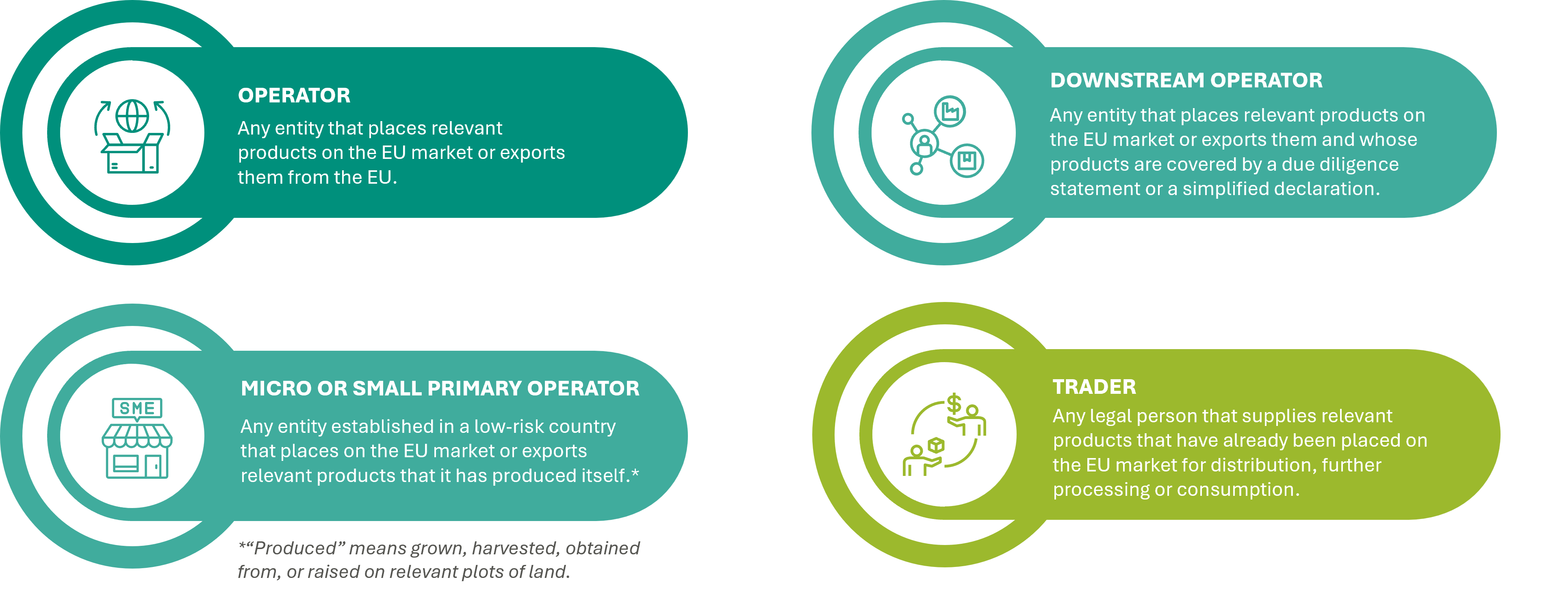
If you are unsure how the regulation applies to your organisation, our free self-assessment tool can help clarify roles and obligations.
>> Access our EUDR Scoping Tool
When does the EUDR apply?
The regulation applies from 30 December 2026 for large and medium-sized organisations. An extended deadline of 30 June 2027 applies to operators that qualified as small or micro undertakings before 30 December 2024, subject to specific conditions. This extension:
- does not apply to downstream operators or traders
- does not apply to wood products previously covered by the EU Timber Regulation (EUTR).
What happens to the EUTR?
The EUDR will replace the EU Timber Regulation (EUTR) once it becomes applicable. However, the EUTR will continue to apply for a transitional period of three years for wood products that:
- were harvested before the EUDR entered into force (29 June 2023); and
- are placed on the EU market on or after the EUDR becomes applicable (30 December 2026).
Commodities and products in scope

| 
| 
| 
| 
| 
| 
|
The EUDR targets seven commodities identified by the EU based on consumption levels and deforestation risk: soy, cattle, oil palm, wood, cocoa, coffee and natural rubber.
For each commodity, the regulation specifies covered products through EU customs codes listed in Annex I. Products not listed in Annex I are generally outside the scope of the regulation.
In July 2026, a Commission Delegated Regulation was published, amending the product scope. Those changes have been reflected in the table below.
*The product does not become in scope of the EUDR until 30 December 2027
| Relevant commodity | Relevant products |
Cattle This Regulation only applies to cattle of the genus Bos and its sub-generas: Bos, Bibos, Novibos, and Poephagus falling under HS subheadings 0102 21 and 0102 29. It does not apply to buffalo (Syncerus genus) or bison (Bison genus) or any other live bovine animals. |
|
Cocoa |
|
Coffee |
|
Oil Palm This Regulation applies to oil palm of Elaeis spp. (including Elaeis guineensis). It does not apply to babassu oil from genus Attalea spp. (including Attalea speciosa) and other vegetable oils from other palm tree species. |
|
Rubber This Regulation applies to rubber of Hevea brasiliensis. It does not apply to balata, gutta-percha, guayule, chicle and similar natural gums produced with other species and to synthetic rubber products. |
|
Soya |
|
Wood This Regulation does not apply to bamboo, rattan and other materials of a woody nature and therefore it does also not apply to relevant products listed under the relevant commodity ‘Wood’ to the extent that those products are made of bamboo, rattan and other materials of a woody nature. |
|
*The product does not become in scope of the EUDR until 30 December 2027
Note: The “ex” prefix indicates that only part of the corresponding customs code is included in Annex I of the EUDR. A given code may cover a wider range of products, of which only certain products fall within the scope of the regulation.
Composite Products
For products made from more than one relevant commodity, only the component classified as the main commodity is subject to EUDR requirements.
For example, in a chocolate bar, only the cocoa-based ingredients fall within the scope.
Products outside the scope of the EUDR
EU customs code not listed in Annex 1
Any EU customs code (CN codes) not listed in Annex 1 of the regulation is considered outside the scope of the EUDR.
Products at the end of their lifecycle
The EUDR does not apply to products made entirely from material that has reached the end of its lifecycle and would otherwise be discarded as waste, except in cases where the material is a by-product of a manufacturing process that involved material not classified as waste (as defined in Article 3, point 1 of Directive 2008/98/EC).
Packaging
Annex I of the EUDR, specifies that:
- due diligence requirements apply to any wood/paper packaging falling under an Annex I customs code, when placed on the market or exported as a product in its own right; and
- packaging falling under CN code 4415 is exempt when used solely as packing material to support, protect or carry another product placed on the market.
The EUDR FAQ provides an update on packaging:
- Packaging material used to support, protect or carry another product is outside scope, regardless of the CN code under which it falls, including paper and cardboard packaging (e.g., CN 4819).
- User Manuals accompanying shipments are not relevant products unless purchased independently.
- Selling or renting used packaging material (such as second-hand pallets) is not subject to the EUDR.
- Empty used packaging already used for this purpose and traded within closed-loop systems is outside the scope.
- Where used packaging is repaired and sold, only new relevant materials used in the repair are subject to due diligence and require a new DDS.
Disclaimer
The information and guidance provided on this webpage are for informational purposes only and do not constitute legal, financial, or professional advice. Preferred by Nature makes no representations or warranties, express or implied, regarding the accuracy, completeness, or suitability of the information contained herein. Preferred by Nature is not liable for the use of, or reliance on, the information provided, nor for any loss arising from such reliance. Responsibility for compliance with the EUDR or any other applicable legislation remains solely with the entity subject to legal obligations.
Jump to a specific section:
Deforestation vs forest degradation
Due diligence requirements
Different requirements for different EU actors
Categories of undertakings
Traceability and geolocation requirements
Deforestation vs forest degradation
The regulation defines clear thresholds for deforestation and forest degradation.
"Deforestation-free" means that products must not contain, be fed with, or be made using commodities from land deforested after 31 December 2020. ‘Deforestation’ is defined as the conversion of forest to agricultural use, whether human-induced or not. For wood-based products, additional requirements apply to ensure that harvesting has not caused forest degradation after this date.
“Forest degradation” is defined using FAO terminology and includes structural changes to forest cover, such as the conversion of primary or naturally regenerating forests into plantation forests.
Compliance with the legislation of the country of production is assessed across eight categories:
- land use rights
- environmental protection
- forest-related regulations including forest management and biodiversity conservation, where directly related to wood harvesting,
- third parties’ rights,
- labour rights,
- human rights protected under international law,
- the principle of free, prior and informed consent, including as set out in the United Nations Declaration on the Rights of Indigenous Peoples,
- tax, anti-corruption, trade and customs regulations
Due diligence requirements
Organisations that place relevant commodities or products on the EU market, or export them from the EU, are considered Operators. Operators must implement a due diligence system as prescribed by the regulation. This includes procedures and measures to ensure that products are deforestation-free and produced in accordance with the country's laws.

Operators must collect supply chain information, assess the risks of non-compliance, and take appropriate risk mitigation measures. Products may only be placed on the EU market or exported once they are assessed as posing no or negligible risk in relation to deforestation-free and legal production requirements.
Operators are also required to report publicly on their due diligence activities on an annual basis.
Country Benchmarks and simplified due diligence requirements
The European Commission will establish a centralised database classifying countries as low, standard or high risk based on deforestation indicators.
Operators sourcing from 'low-risk' countries may apply simplified due diligence. However, risks related to mixing or indirect sourcing must still be assessed. The intensity of enforcement will vary according to country risk classification.
Certification and third-party schemes
The EUDR recognises that certification and third-party verified schemes can support risk assessment and mitigation. However, such schemes do not replace an operator’s responsibility under the regulation and must be assessed for their scope, credibility and relevance to EUDR requirements.
Different requirements for different EU actors
Responsibilities under the EUDR vary depending on the size of the organisation and its role in the supply chain.
Operators
 Operators are organisations that place relevant products on the EU market or export them from the EU. This includes organisations that import products into the EU, as well as those that produce them within the EU, for example by growing commodities such as wood, coffee or soy, or by raising cattle.
Under the EUDR, operators are required to exercise due diligence to ensure that the products they place on the market are deforestation-free or, in the case of wood, free from forest degradation, and that they have been legally produced in accordance with the applicable legislation of the country of production.
To meet these obligations, operators must:
- collect the information required under Article 9 of the EUDR,
- assess the risk of non-compliance based on that information, taking into account the risk assessment criteria set out in Article 10, and
- mitigate any identified risks in line with Article 11.
To exercise due diligence effectively, operators must have a due diligence system in place. This system consists of documented procedures describing how the organisation collects information, carries out risk assessments and implements risk mitigation measures.
To demonstrate that due diligence has been exercised, operators must submit a due diligence statement to the EU Information System before placing a relevant product on the EU market or exporting it.
Micro and small primary operators
 Micro and small primary operators are organisations that place relevant products on the EU market or export them where those products have been grown, harvested or raised by the organisation itself.
Like all operators, micro and small primary operators are required to exercise due diligence to ensure that their products are deforestation-free and legally produced.
However, because these operators must be established in countries classified as low risk, simplified due diligence applies. This means they are not required to carry out a formal risk assessment or implement risk mitigation measures. Instead, their due diligence obligations focus on collecting the information required under Article 9 of the EUDR and confirming compliance with the core requirements of the Regulation.
Micro and small primary operators are not required to submit a due diligence statement. Instead, they may submit a simplified due diligence declaration to the Information System, which involves less extensive information requirements than a full due diligence statement.
Downstream operators and traders
 Downstream operators and traders are subject to reduced obligations under the EUDR.
Before placing a relevant product on the market, exporting it or making it available, they must collect basic information about their suppliers, including the supplier’s name, address and email contact details. In addition, where a downstream operator or trader is the first downstream actor in the supply chain, meaning that their direct supplier is an operator, they must also collect and retain the reference number of the due diligence statement or the identifier of the simplified due diligence declaration.
All of this information must be retained for a period of five years.
Non-SME downstream operators and traders are subject to additional requirements. They must register in the Information System and, if they become aware of substantiated concerns indicating potential non-compliance, they are required to verify that due diligence was properly exercised by the initial operator.
Categories of undertakings: must not exceed the limits of at least two of the three following criteria (large undertakings must exceed the limits of at least two):
Micro-undertakings
| Small undertakings
|
Medium-sized undertakings
| Large undertakings
|
Unsure if the EUDR applies to your company? Use our self-assessment tool to help you determine your obligations.
>>Access our EUDR Scoping Tool
Traceability and geolocation requirements
Operators must be able to trace products back to the plots of land where they were produced or harvested. For plots larger than four hectares, polygon data is required. Smaller plots may be represented by a single coordinate point.
The European Commission is developing a central Information System to manage due diligence statements and customs processes.
Disclaimer
The information and guidance provided on this webpage are for informational purposes only and do not constitute legal, financial, or professional advice. Preferred by Nature makes no representations or warranties, express or implied, regarding the accuracy, completeness, or suitability of the information contained herein. Preferred by Nature is not liable for the use of, or reliance on, the information provided, nor for any loss arising from such reliance. Responsibility for compliance with the EUDR or any other applicable legislation remains solely with the entity subject to legal obligations.
Info sheet
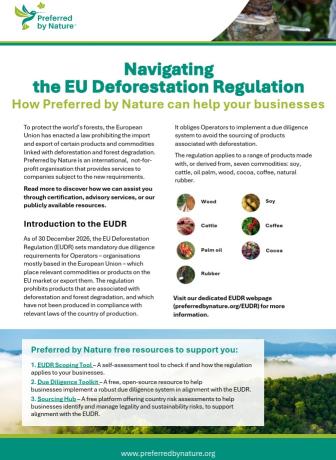
EUDR Service info sheet
The EU Deforestation Regulation (EUDR) prohibits products and commodities linked with deforestation and forest degradation from being imported into the EU market or exported from ...
The EU Deforestation Regulation (EUDR) prohibits products and commodities linked with deforestation and forest degradation from being imported into the EU market or exported from ...
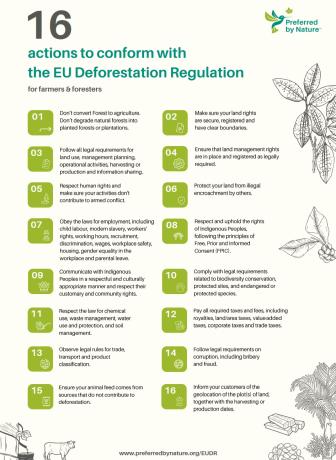
Template

Guidelines for EUDR Due Diligence System preparation
This document provides clear instructions and practical steps for preparing Due Diligence Systems (DDS) to meet the requirements of the EU Deforestation Regulation (EUDR). It is d...
This document provides clear instructions and practical steps for preparing Due Diligence Systems (DDS) to meet the requirements of the EU Deforestation Regulation (EUDR). It is d...
Preferred by Nature Certification Standards
PBN-03 Due Diligence Standard for Product Conformance
Due diligence system requirements including EUDR module, defines requirements for implementing due diligence to ensure product conformance and includes an EUDR-specific module. ...
Due diligence system requirements including EUDR module, defines requirements for implementing due diligence to ensure product conformance and includes an EUDR-specific module. ...
PBN-02 Systems Standard
Certification system implementation requirements specify the organizational and management system requirements needed to implement and maintain Preferred by Nature Sustainability ...
Certification system implementation requirements specify the organizational and management system requirements needed to implement and maintain Preferred by Nature Sustainability ...
Geospatial Data Sharing Protocol
Geospatial Data Sharing Protocol For deforestation-free commodity value chains
The Protocol is intended to be a voluntary standard for providing a uniform means for sharing geospatial data. This will allow organisations to exchange geospatial data efficientl...
The Protocol is intended to be a voluntary standard for providing a uniform means for sharing geospatial data. This will allow organisations to exchange geospatial data efficientl...
Frequently Asked Questions (FAQs) - Geospatial Data Sharing Protocol
This document outlines all the frequently asked questions related to the Geospatial Data Sharing (GDS) Protocol. It aims to provide clarity and understanding for those interested ...
This document outlines all the frequently asked questions related to the Geospatial Data Sharing (GDS) Protocol. It aims to provide clarity and understanding for those interested ...
Consultation comments - Geospatial Data Sharing Protocol
The Geospatial Data Sharing (GDS) Protocol's first version was developed in mid-2023 with FAO's support to improve commodity production monitoring. Following expert group input a...
The Geospatial Data Sharing (GDS) Protocol's first version was developed in mid-2023 with FAO's support to improve commodity production monitoring. Following expert group input a...
Videos


Get in contact with us
Our experts are ready to support you on your sustainability journey.