EUDR- Tackling deforestation and forest degradation in agricultural and forestry supply chains
What is the EUDR?
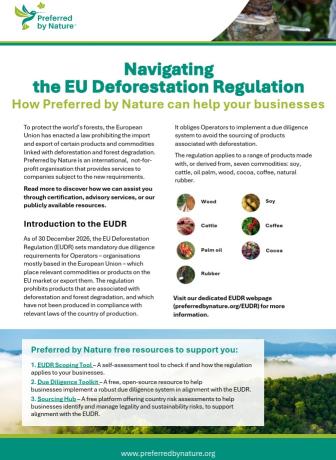
The EU Deforestation Regulation (EUDR) aims to ensure that certain agricultural and forestry products placed on, or exported from, the EU market are not linked to deforestation, forest degradation, or illegal production. It introduces due diligence requirements for organisations that place relevant products on the EU market or export them.
Unsure where to begin?
Whether you are just starting to explore the EUDR or are already preparing for compliance, the resources below can help you move forward.
New to the EUDR?
Learn more about the EUDR Get a clear overview of the regulation, its objectives, and who it applies to.
Not sure what the EUDR means for your organisation?
Find out how the EUDR applies to you Use our free scoping tool to understand your role under the EUDR and which obligations may apply to your organisation.
Ready to implement the EUDR?
Explore our Due Diligence Toolkit Access free tools, templates and guidance to support the development and implementation of a due diligence system.
Our Due Diligence Toolkit is a free, open-source resource designed to help businesses meet EUDR requirements. The toolkit covers key elements of due diligence, including supply chain mapping, deforestation and legality risk assessment, and risk mitigation planning. It is designed to be practical and adaptable across forest and agricultural commodity supply chains.
Is your business affected by the EUDR? Our free self-assessment tool can help you determine whether the regulation applies to your activities and what your obligations may be.
Updated to reflect the amendments in force since December 2025, the Scoping Tool:
Provides clear results as you complete the survey
Clarifies whether your activities fall within the EUDR scope
Helps you understand your roles and obligations under the regulation
The EUDR applies to seven commodities identified by the EU due to their consumption volumes and associated deforestation risk: timber, rubber, soy, palm oil, coffee, cocoa and cattle.
Looking for further support in aligning your business practices with the EUDR? Discover how Preferred by Nature can help!
Sustainability advisory services
Preferred by Nature supports organisations in addressing sustainability and sourcing challenges in line with market and regulatory requirements, including the EUDR. Our advisory services cover the full sustainable sourcing journey, from setting commitments and policies to due diligence system design, implementation, reporting and disclosure. We work with organisations of different sizes and roles across global supply chains to support practical alignment with EUDR requirements.
We organise seminars and webinars worldwide to build understanding of the EUDR and its requirements. In addition, we offer structured EUDR due diligence training courses designed to support organisations seeking a deeper and more practical knowledge of the regulation.
Preferred by Nature Certification applies a risk-based approach suitable for companies and land managers across commodities. The certification is based on our Sustainability Framework, which has been updated to align with EUDR requirements. Our certification and verification services support businesses in addressing legal compliance, land use and manufacturing practices, and broader sustainability considerations, helping to simplify due diligence for responsible sourcing.
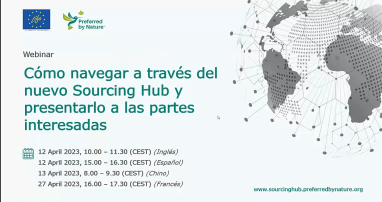
Access country-level risk assessments to support responsible sourcing decisions across timber, palm oil, soy, biomass and cattle supply chains in 70+ countries. The Sourcing Hub helps organisations identify and address legality risks and is being expanded to include sustainability risks such as deforestation. Coverage will extend to all seven commodities covered by the EUDR.
Developed in partnership with the Food and Agriculture Organization (FAO), the Geospatial Data Sharing Protocol improves traceability and responsible data sharing across global supply chains through a structured approach to managing geolocation information. The protocol supports organisations in meeting regulatory requirements such as the EUDR, including those related to the geolocation of harvesting plots.
For organisations already using FSC certification, the Regulatory Module offers a practical route to address EUDR requirements within an established system. It builds on existing FSC due diligence and risk assessment processes and can be assessed either on its own or alongside an annual FSC audit. Preferred by Nature is accredited to carry out evaluations against the FSC Regulatory Module worldwide.
For PEFC Chain of Custody certificate holders, the PEFC EUDR Due Diligence System provides a structured way to address EUDR-related obligations. The DDS focuses on due diligence and risk assessment and can be evaluated as a standalone desk assessment or integrated into regular certification audits. Preferred by Nature is accredited to evaluate conformance with the PEFC EUDR DDS worldwide.