What is SURE?
SURE (Sustainable Resources Verification Scheme) operates SURE-EU, a voluntary certification scheme recognised by the European Commission. The scheme covers compliance with the EU Renewable Energy Directive (RED) sustainability and greenhouse gas emission-saving requirements.
SURE-EU covers solid and gaseous biomass fuels used to generate electricity, heating and cooling. It provides a framework to verify how biomass is produced, collected, processed, traded and used for energy.
>> Learn more on the SURE-EU website
>> Download our SURE-EU Info sheet
SURE-EU certification
SURE-EU certification provides independent confirmation that an organisation’s relevant activities comply with the applicable scheme requirements. These requirements cover sustainable biomass production and sourcing, material traceability, mass balancing, and greenhouse gas information across the supply chain.
The certification scope depends on the type of biomass and the organisation’s role, ranging from biomass production and collection to processing, trading and energy generation. Not all operators are certified in the same way: certain biomass producers may be covered through group arrangements or other scheme-defined verification routes.
Five benefits of choosing SURE-EU certification:
- Demonstrate RED compliance. Provide independently verified evidence of compliance with applicable sustainability and greenhouse gas requirements under the EU Renewable Energy Directive.
- Support market access. Meet sustainability assurance expectations for bioenergy supply chains where SURE-EU certification is recognised.
- Cover the bioenergy supply chain. Use a single recognised framework for agricultural biomass, forest biomass, and relevant waste and residues.
- Strengthen traceability. Maintain clear records of material origins, quantities, sustainability characteristics and relevant greenhouse gas data.
- Build confidence through independent verification. Demonstrate that your operations are evaluated against published criteria by an approved certification body.
External resources
For the latest official rules, scheme forms and certificate information, consult the SURE website:
- SURE-EU scheme overview — Introduction to the certification scheme and its scope.
- SURE media library — Current scheme documents, self-declarations, guidance and other public materials.
- SURE public certificate database — Search certificate status, scope and validity.
How is the certification process?
Start your SURE-EU certification journey with Preferred by Nature. The certification process involves registration with SURE, preparation for the audit, independent evaluation and a certification decision. We guide you through the certification process and help determine the scope applicable to your organisation.
Step 1: Register with SURE
Register the relevant facility and the intended certification scope in the SURE database and conclude the scheme agreement with SURE.
>> SURE registration and certification information
Step 2: Apply to Preferred by Nature
Share your SURE participant information and details of your business activities, biomass sources, facilities and existing sustainability certification. We confirm the applicable certification scope, prepare a service proposal and conclude the certification agreement.
Step 3: Preferred by Nature completes SURE linkage
Following the certification agreement, Preferred by Nature submits the required legally binding declaration to SURE, confirming its appointment as your certification body and establishing the necessary links in the SURE database.
Step 4: Prepare your system
Establish the procedures and evidence applicable to your activities. This may include supplier information, self-declarations, documented material flows, traceability and mass-balance records, evidence of biomass origin and sustainability, greenhouse gas data and other relevant documentation, depending on your certification scope.
Step 5: Undergo the audit
Our qualified auditors assess your operations through an on-site audit, including document and record reviews, interviews and observations at facilities or sourcing locations, as applicable. Where group certification or sample inspections apply, the evaluation also covers the relevant arrangements and locations. Any identified non-conformities must be addressed in accordance with SURE requirements.
Step 6: Certification and renewal
Following the audit, we prepare the report,conduct an independent review and make a certification decision. After a positive decision, Preferred by Nature issues the SURE-EU certificate and records the relevant information in the SURE database. Certificates are normally valid for 12 months and are renewed through annual re-certification.
>> Search the public SURE certificate database
Complaints and resolutions
If a complaint is raised about our certification services or one of our clients, we handle it in accordance with our Dispute Resolution Policy. We may involve our Impartiality Committee if Preferred by Nature’s impartiality is questioned.
Certificate scope
The scope of SURE-EU certification depends on the biomass type, your position in the supply chain and the activities carried out at each site. We help identify which requirements and verification arrangements are relevant to your operation.
Who can be certified?
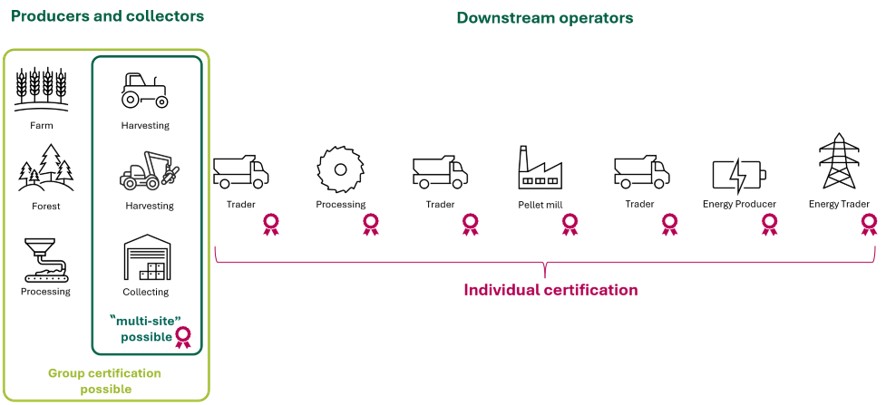
- Biomass producers. Organisations that produce agricultural or forest biomass, or generate waste and residues from biomass. Biomass producers are commonly verified through group certification arrangements, although individual certification is also possible.
- First gathering points and collectors. Operations that first receive agricultural or forest biomass, or collect relevant waste and residues from their producers. At this stage of the supply chain, several dependent storage or operating sites may be covered under one certificate, subject to specific SURE requirements.
- Processing plants. Facilities that process biomass or biomass fuels, including related activities such as pellet and biogas production.
- Suppliers and traders. Organisations that supply or trade biomass or biomass fuels through the certified supply chain, including relevant activities without physical handling.
- Energy producers. Plants that convert sustainable solid or gaseous biomass fuels into electricity, heating or cooling (referred to as last interfaces in the SURE scheme).
Energy suppliers and distributors. Organisations that supply or distribute electricity or heat generated from sustainable biomass fuels (referred to as service providers after the last interface).
Example: Is a harvesting company a biomass producer or a first gathering point?
A harvesting company may act as a forest biomass producer, a first gathering point, or both, depending on its responsibilities and activities:
- Forest biomass producer: If the company manages forest areas and has full power of disposition over the land, it may be considered a biomass producer, even when harvesting occurs across several sourcing areas. In this case, the company is responsible for demonstrating compliance with the applicable requirements for forest biomass production.
- First gathering point: If the company harvests or collects biomass from forests managed by other producers, takes control of the biomass and supplies it onwards, it is generally considered a first gathering point. In this case, the company must ensure that its upstream biomass producers comply with the applicable SURE requirements through the relevant verification arrangements.
A company carrying out both activities may need to include both scopes in its certification. The distinction depends on actual forest management responsibilities and control over the biomass, not the harvesting activity alone.
Certification by biomass type
Agricultural biomass
Certification and inspection requirements address agricultural production, including relevant agricultural residues, and the protection of land, soil, biodiversity and carbon stocks.
Where CAP-Conditionality applies, compliance with certain agricultural management criteria can be demonstrated using existing CAP-related evidence. Requirements not covered by CAP-Conditionality, or where it does not apply, must be verified separately.
Forest biomass
Certification and inspection requirements cover forest biomass production, including relevant forestry residues, and sustainability criteria for harvesting, biodiversity, soil protection, forest regeneration and carbon stocks.
A recognised risk assessment can support a low-risk (Level A) verification approach. Where specified risks are identified (Level B) or an appropriate risk assessment is unavailable, more extensive verification at the sourcing area is required.
Waste and residues from biomass
Certification and inspection requirements address the classification, origin, traceability and plausibility of quantities of waste and residues from biomass.
For waste and residue producers, risk assessments may yield low-, medium- or high-risk profiles, depending on the material’s type and origin, supply chain complexity, potential risks of misclassification or mixing, and other relevant factors. The scope and frequency of inspections may vary accordingly.
Agricultural and forestry residues generated directly during agricultural or forestry activities are covered by their respective agricultural or forest biomass requirements.
What will the audit cover?
All certified economic operators must demonstrate compliance with the applicable SURE-EU requirements. Depending on the scope of the certification, the audit may include:
- Biomass producers and group managers: Production-related sustainability criteria, biomass origin, relevant documentation and verification of producers or group members.
- First gathering points and collectors: Supplier verification, incoming material checks, classification of materials, traceability and mass-balance records.
- Processing plants: Material sourcing, processing records, conversion factors, traceability and mass balance.
- Suppliers, traders and distributors: Purchase and sales records, transfer of sustainability information, traceability and mass balance, as applicable.
- Energy producers: Sustainable biomass fuel inputs, energy generation, applicable plant-specific requirements and greenhouse gas emission-saving calculations.
Greenhouse gas emissions data and emissions-saving requirements may also be verified at various stages of the supply chain, depending on the activities and responsibilities of each economic operator.
Individual certification and group arrangements
Individual certification
Individual certification is generally required for independent operations across the supply chain, including first gathering points, collectors, processing plants, suppliers, traders and energy producers. Certification is site-specific and covers the activities carried out at the certified location.
Group certification
Group certification is available to producers of agricultural biomass, forest biomass, and waste and residues. A group manager (a biomass producer, first gathering point or collector) is responsible for managing the group and ensuring compliance with the applicable requirements. Group members are subject to verification and inspections according to the relevant SURE-EU rules.
Dependent storage and operating sites
Dependent or non-autonomous storage and operating sites may be included in the certification of first gathering points or collectors, subject to specific inspection requirements:
- First gathering points: sample inspections of dependent sites.
- Collectors: annual on-site inspections of all dependent sites.
This arrangement does not extend to downstream processing, trading or energy-production operations, which require individual site certification.
Preferred by Nature service scope
Preferred by Nature currently provides SURE-EU certification to organisations that already hold another sustainability certification (e.g. FSC, PEFC, SBP, PBN SFC) relevant to their operations. The existing certification need not be issued by Preferred by Nature.
This is a Preferred by Nature service condition, not a SURE-EU scheme eligibility requirement.
Unsure which route applies?
Contact us to discuss your activities, site structure and biomass sources. We can help you identify the appropriate certification scope and verification requirements.
Standards overview
SURE-EU publishes scheme principles and technical guidance covering various activities across the biomass supply chain. Some requirements apply to all scheme participants, while others depend on the type of biomass and the activities carried out. The English versions of the SURE scheme documents are binding.
Scheme framework and supply-chain requirements
- Scope and basic scheme requirements of the SURE system (GSP-B) — Defines the overall SURE-EU framework, including sustainability requirements, traceability, greenhouse gas emissions and participation in the scheme.
- Scheme principles for the certification process (GSP-CP) — Establishes requirements for audits, inspections, certification procedures and group arrangements.
- Scheme principles for the use, processing and distribution/trade of biomass fuels (SSP-USE) — Sets requirements for operations downstream of biomass production, including the gathering, collection, processing, trading and conversion of biomass fuels into electricity and heat.
Biomass production requirements
- Production of agricultural biomass (SSP-AGRI) — Established sustainability criteria for agricultural biomass production, including relevant agricultural residues.
- Production of forest biomass (SSP-FOREST) — Defines sustainability and harvesting requirements for forest biomass production, including a risk-based verification approach.
- Production of waste and residues from biomass (SSP-WaR) — Covers the classification, origin and verification of biomass-derived waste and residues.
Important technical guidance
- Technical guidance for mass balancing (TG-MASS) — Outlines traceability and mass-balance requirements across the biomass supply chain, including biomass producers.
- Technical guidance for greenhouse gas calculation (TG-GHG) — Provides methodologies and data requirements for calculating greenhouse gas emissions and, where applicable, emission savings.
- Risk assessment of unsustainable forest biomass production (TG-RA) — Provides the methodology for assessing sustainability risks in forest biomass sourcing areas.
Additional SURE documents
Other scheme documents may apply depending on the scope, including guidance on harvesting restrictions, definitions, integrity management, permitted audit methods and special transitional requirements.
Because the scheme is updated periodically, always consult the latest official SURE document library before preparing for certification.
Info sheet

SURE-EU Info Sheet
Learn more about the SURE-EU Verification Scheme, a European Commission-recognised certification scheme that supports sustainable biomass production and supply chains in line with...
Learn more about the SURE-EU Verification Scheme, a European Commission-recognised certification scheme that supports sustainable biomass production and supply chains in line with...
How the Preferred by Nature Sustainability Framework Certification scheme is governed
The Preferred by Nature Sustainability Framework Certification (PBN SFC) scheme operates under a governance system designed to support transparency, impartiality, accountability and stakeholder participation.
The system defines how the scheme is managed, how standards and procedures are developed and revised, and how certification activities are independently assessed and overseen.
The scheme owner and the certification body are separate legal entities, with different staff, reporting lines and responsibilities. The scheme is owned by Preferred by Nature F.M.B.A. in Denmark, while certification is carried out by Preferred by Nature OÜ in Estonia, which holds the accreditation under which all certification activities are performed and takes certification decisions independently. Both entities sit within the Preferred by Nature organisational umbrella.
The scheme's governance structure also includes internal decision-making bodies, external stakeholder representation and mechanisms for stakeholder engagement and dispute resolution.
Scheme governance documents
The following documents describe the governance structure, procedures and requirements supporting the operation and integrity of the PBN SFC scheme.
Governance structure, roles and responsibilities
Explains how the PBN SFC scheme is governed, including the responsibilities of its governance bodies, decision-making processes, stakeholder participation and dispute handling.
Standard development and revision
Describes how PBN SFC standards are developed, reviewed and revised, including stakeholder consultations, approval processes and transition arrangements.
Development and revision of SFC scheme documents
Sets out the procedures for developing, reviewing, approving and publishing scheme documents other than normative standards, including governance procedures and supporting documents.
Requirements for accreditation bodies
Defines the requirements for accreditation bodies overseeing certification bodies operating under Preferred by Nature Sustainability Framework Certification, including competence, impartiality, information sharing and cooperation with the scheme owner.
Assurance requirements
Establishes the requirements for certification bodies conducting PBN SFC audits and certification activities, including auditor competence, certification decisions, surveillance, impartiality and quality assurance.
Get in contact with us
Our experts are ready to support you on your sustainability journey.